

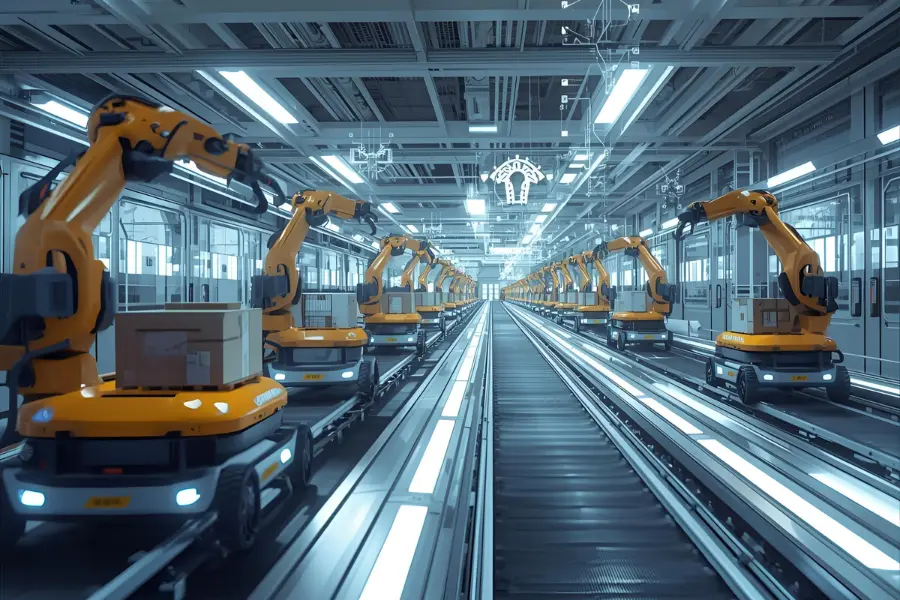
Material handling has always been about movement — moving product efficiently, safely, and predictably from one place to another. What’s changing is how those movements are planned, monitored, and improved. AI isn’t replacing the core principles of good warehouse design or thoughtful workflow planning, but it can add intelligence to the system that helps businesses anticipate needs, eliminate waste, and react faster than manual systems ever could. The result is a supply chain that feels less reactive and more intuitive.
Smarter Palletizing and Picking
Traditional automation handles repetition. AI learns patterns. In a growing number of warehouses, AI-driven robots identify product size, weight, and orientation in real time, stacking pallets in stronger, more stable configurations. In picking areas, vision systems and machine learning help robots navigate mixed inventory, recognize items, and adapt on the fly without constant reprogramming. Instead of following only pre-set rules, these systems improve as they work — a small shift with big efficiency gains in busy operations.
Predictive Inventory and Space Planning
AI also excels at seeing trends humans can miss, especially in facilities juggling fast-moving items, seasonal surges, or irregular order volume. For example, AI systems can analyze historical data and current activity to forecast whatinventory will need to move sooner, where congestion is likely, and how to position materials for smooth flow. Imagine a warehouse that reorganizes itself not reactively, but proactively in anticipation of incoming volume. That’s where many operations are heading, and the payoff shows up in reduced travel time, better shelf utilization, and fewer bottlenecks.
Safety With a Digital Co-Pilot
Material handling environments move fast, and safety always sits at the center. AI-powered monitoring systems can track pedestrian paths, forklift patterns, and equipment activity to identify near-misses before they become incidents. When a corner consistently sees close calls, the system flags it. When equipment operators show fatigue patterns or inconsistent motion, managers get early insight. Instead of reacting to accidents, facilities using AI can adjust layout, signage, or workflow based on real data.
AI in Conveyor and AMR Systems
Autonomous mobile robots (AMRs) have moved beyond guided routes. Powered by AI, they navigate changing environments, avoid obstacles, and adjust routes without human intervention. Conveyors and sortation systems can balance loads dynamically and direct cartons or totes toward the fastest available lane. These tools don’t just move product — they respond to real-time demand, making the whole line feel more adaptive and efficient.
A Future Built on Collaboration
AI doesn’t eliminate the need for human intuition or good operational judgment. It enhances both. Workers in these environments move into roles where oversight, problem-solving, and technical skill matter. Teams get better tools, operations become more predictable, and customers benefit from faster, more reliable service. Even smaller facilities are starting to see accessible AI-driven tools that add value without requiring a complete system overhaul.
Material handling has always seen change — from manual carts to forklifts, from static racks to dynamic storage. AI is simply the next chapter in the industry, bringing learning and foresight to equipment and workflows already built for movement. The technology will keep improving, but the core idea stays simple: make work smoother, safer, and more efficient. As AI material handling solutions become a natural part of warehouse life, operations that embrace it early will feel the advantage first — not just in speed, but in clarity and confidence across the entire process.

